

CONFERENCE
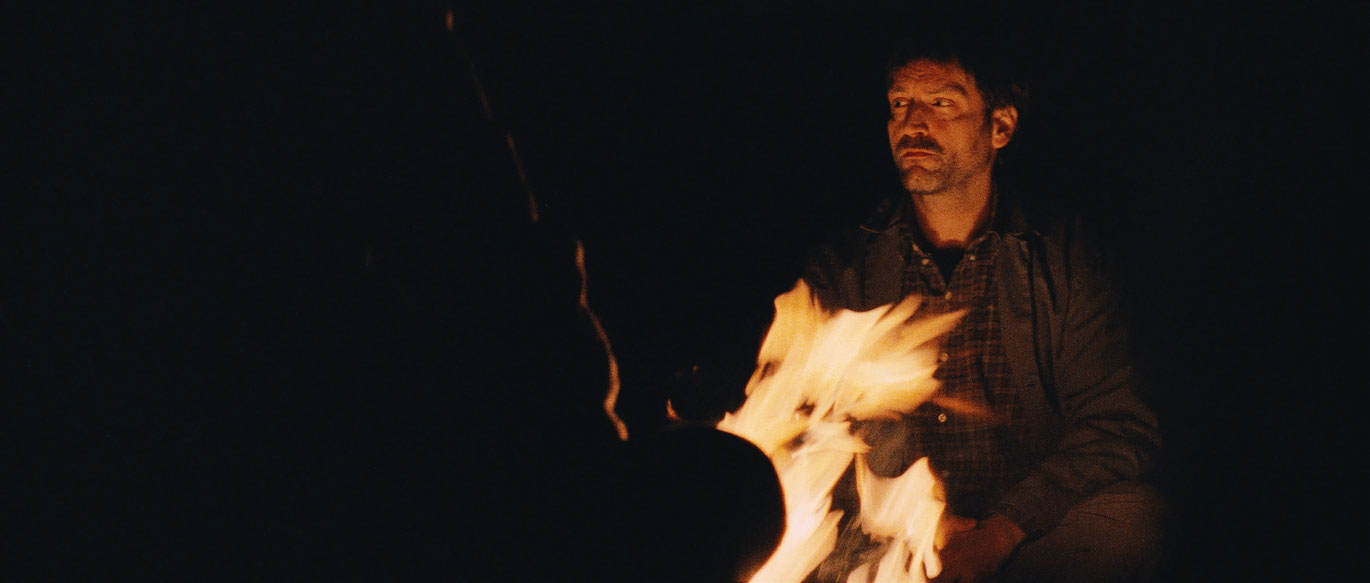
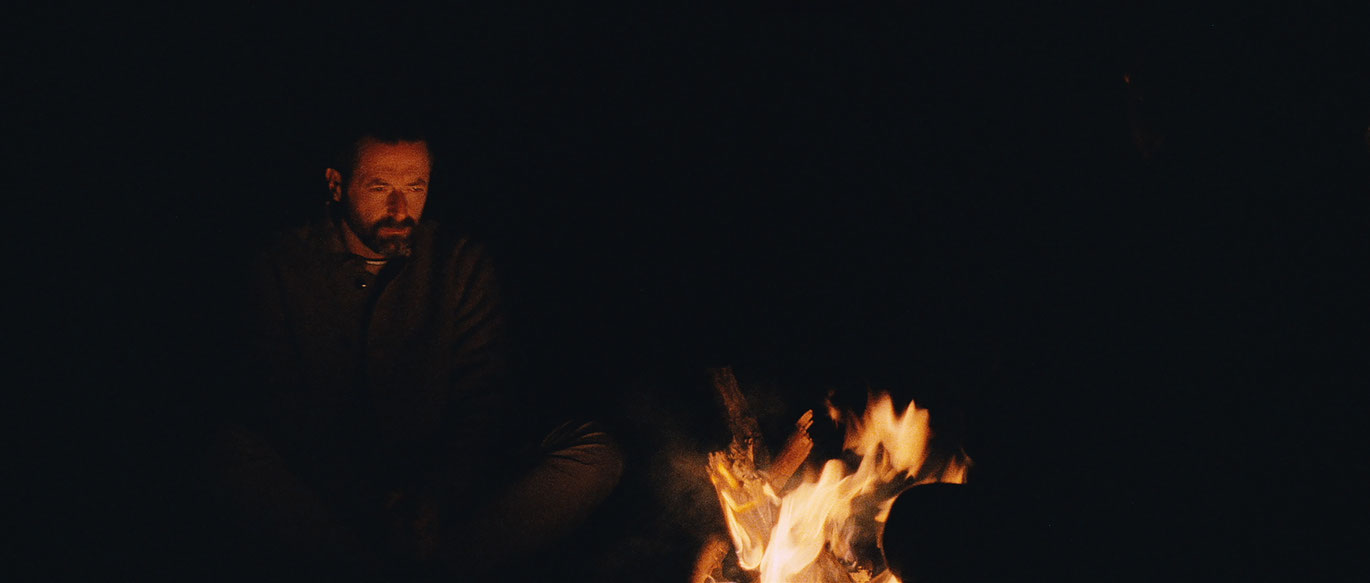
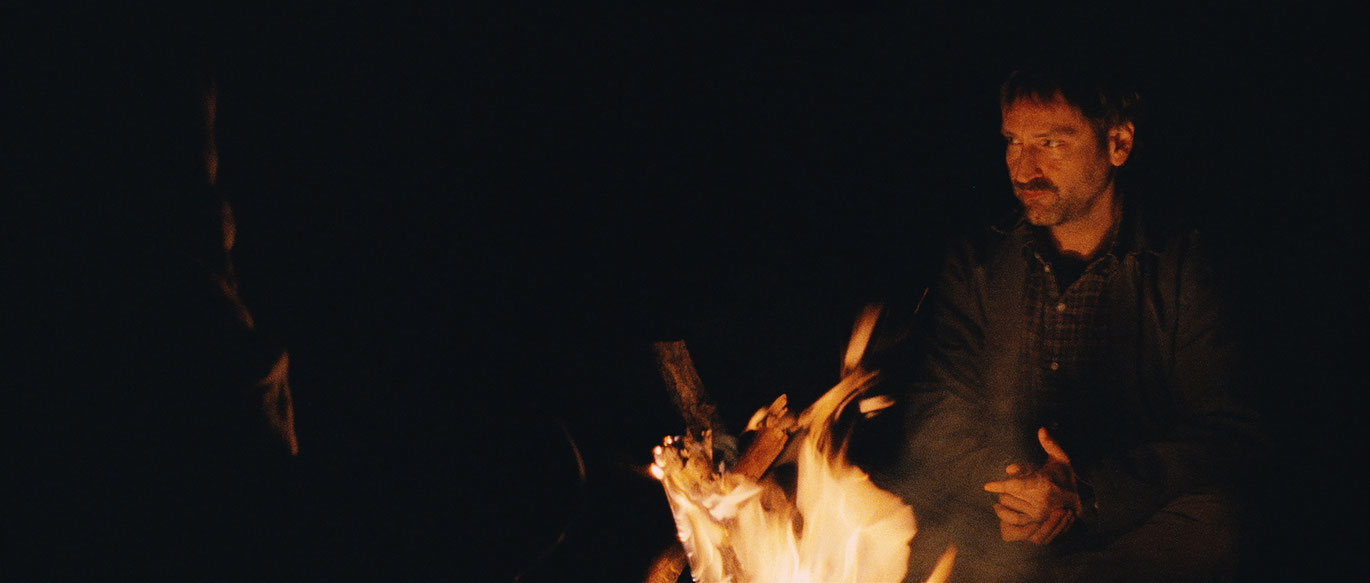
With Conference (2025), once again shot in 35mm Cinemascope, Björn Kämmerer enriches his diverse body of work—following films such as Gyre (2009) or Arena (2017)—with another innovative merry-go-round: a silent, high-tension drama of glances centered around a campfire, a scene reminiscent of a fictional Western (or Ostern). For the first time, Kämmerer employs performers, and with them, he stages subtle physiognomic duels that elevate the film into an exciting perpetuum mobile—a utopian machine driven by three individuals rotating restlessly around the flickering light, that is, by their secret interiors, waiting to be deciphered upon their faces. (Thomas Korschil)
A Match of Cutting Gazes
Both dissemble and disguise their true face behind expressions they have assumed. Each tries to discover what lies behind the other’s mask. And, by using their facial expressions to attack each other and to defend themselves, each strives to provoke his interlocutor into giving himself away by assuming a treacherous expression.
In Conference, where three men sitting opposite in pairs revolve around a wood fire—its flickering lifting their faces warmly out of an otherwise entirely empty, pitch-black scene—Björn Kämmerer stages physiognomic duels of the kind Béla Balázs described more than 100 years ago. For the first time the filmmaker employs actors, who incessantly rotate around the light, while it remains unclear what they are sitting on, or whether they are even hovering above the ground. They are, in themselves, almost motionless: no one speaks, hardly a face moves, everyone is gazing.
Like earlier works in Kämmerer’s steadily growing oeuvre, spanning over two decades and in many ways courageously anachronistic, Conference is shot on 35mm film in Cinemascope widescreen format without sound. In contrast to his other films realized in a single take—in which the artist has previously rotated a wooden hut, bundles of window sashes or even an entire theater grandstand—the revolution here is discontinuous, making its origin ambiguous. Segments of uniform length (2 seconds each) and a consistent sequence of the three men (who resemble one another and only become distinguishable over time) result in a leisurely 4/4 time (♩=30)—slow enough to trace the multilayered drama of this speechless conversation developing from the subtle transformations of an initially repetitive arrangement.
The montage fragments the circumference and transforms the conventional, binary shot-reverse shot structure into a complex figure. It is not actually the camera that changes perspective—though it looks at the events from slightly shifted vantage points and varying distances—but rather the individuals who jump to the opposite side of the circle through the edit. As two men initially stare into the fire for a good while (with silhouetted backs moving through the darkness in the foreground), with time neither can elude the insistent gaze of the third, who is constantly interposed between them.
With the reciprocation of looks, the ensemble of humans and mechanics quickly gathers speed. Soon, each person looks from the second to the third, so that, without ever being in the same frame simultaneously, together they form a virtual circle of gazing and being gazed at. Linked through multiple triangulations, they all seem to lie in wait for one another, as if expecting signs from their counterparts that would reveal insight into their respective thoughts or intentions.
What has happened, or maybe is about to happen, amidst this tense campfire romanticism played at a somber Grave tempo? Is something threatening hovering between these men of inquiring expressions, who apparently try not to expose anything, albeit micro-movements repeatedly escape them, consciously or unconsciously? These are the details that Kämmerer picks up on to stage his drama, to which the other players then must respond, while we, as viewers, also attempt to decipher them. Perhaps as betrayal, mistrust, deception or disappointment?
By reaching back to an early mode of cinema, Conference creates yet another exciting (pseudo-)perpetuum mobile—a utopian machine that pretends to generate energy out of nothing while simultaneously attempting to fathom its own, not quite known, inner drive. Thus, he also recalls Béla Balázs's hope for silent film—a term only applied retrospectively from the perspective of sound—as an independent art form liberated from the language of literature and theater, which would revolutionize seeing and return to faces and bodies their immediate, and as such, eloquent physiognomic expression.
(Thomas Korschil)
Quote: Béla Balázs, Visible Man, in: Early Film Theory, New York 2011 [Vienna 1924], 36f.
CONFERENCE
2025
Austria
9 min